
The real world physics (and a little chemistry) of a Fireball spell
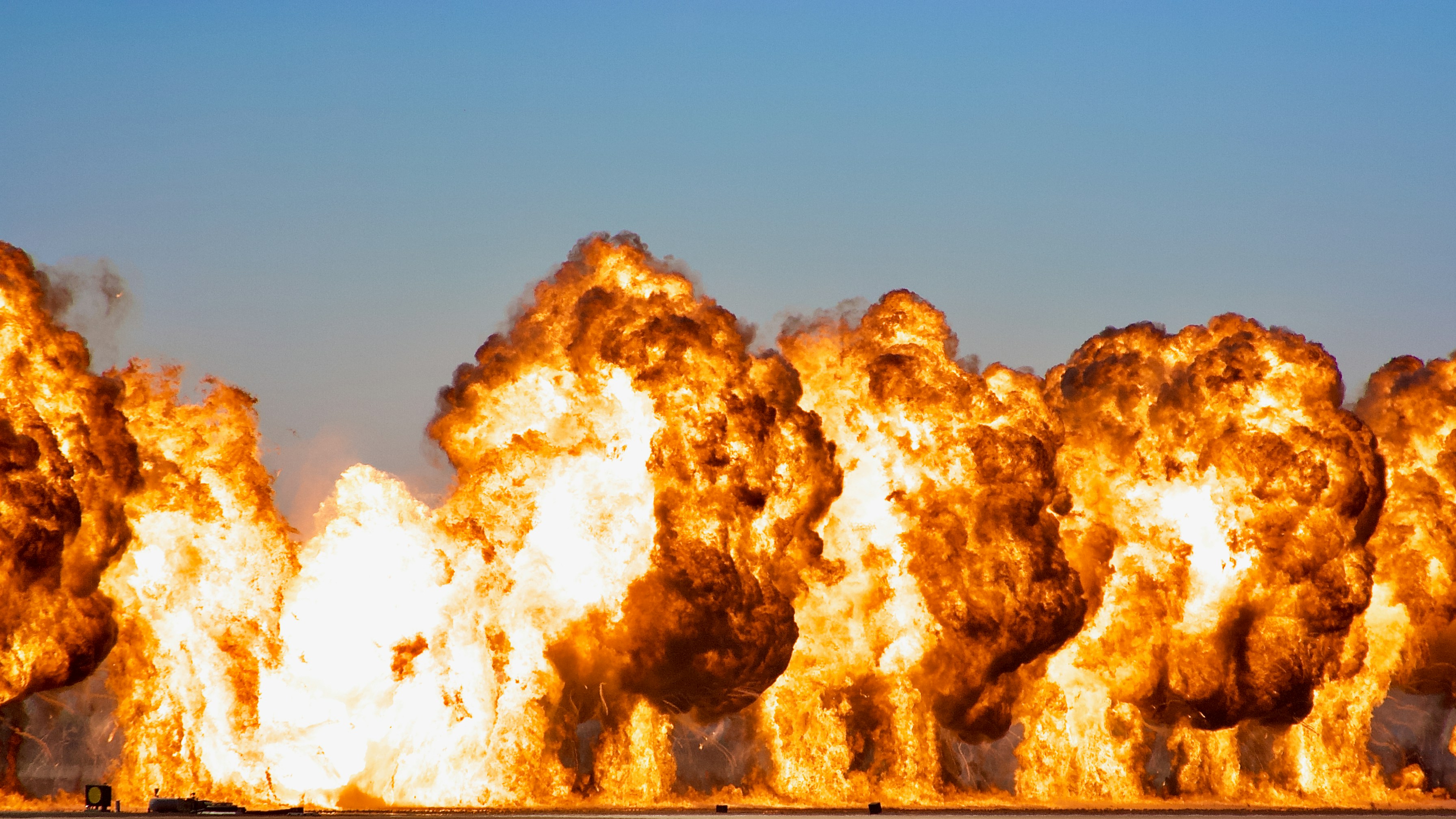
The most important question for a GM (or other players) to ask when the party spellcaster enthusiastically yells, “I cast Fireball,” is “are you sure about that?”

Let’s start with some context: IRL, one of the things I do is volunteer as a firefighter, so I have a little bit of experience at observing fire behaviour outdoors, and have seen more than enough training video about fire behaviour in enclosed spaces to be very wary of it. I've also both GMed and played when Fireball has been cast and the physics and chemistry of what should happen not been considered; the magic fire just burns. Even better, I have been at the hot end of a Fireball going off when a clever DM did understand the consequences and let the party experience them first hand.
As one of the defining spells of the D&D experience, Fireball is going to be cast by one of your game’s magic wielders at some point. But have you, or they, considered how fire and explosions behave, and what that explosion might do if it’s not in the middle of an open field?
A Fireball recap
Let's quickly take a look at what the current 5e and 5.5e descriptions of Fireball have to say.
The 2014 Player's Handbook block for Fireball reads:
FIREBALL
3rd~level evocation
Casting Time: 1 action
Range: 150 feet
Components: V,S, M(a tiny ball of bat guano and sulfur)
Duration: Instantaneous
A bright streak flashes from your pointing finger to a point you choose within range and then blossoms with a low roar into an explosion of flame. Each creature in a 20-foot-radius sphere centered on that point must make a Dexterity saving throw. A target takes 8d6 fire damage on a failed save, or half as much damage on a successful one.
The fire spreads around corners. It ignites flammable objects in the area that aren't being worn or carried.
At Higher Levels. When you east this spell using a spell slot of 4th level or higher, the damage increases by 1d6 for each slot level above 3rd.
So far, so uncontroversial. How about the 2024 version (which is the same in the SRD 5.2.1, as expected):
Fireball
Level 3 Evocation (Sorcerer, Wizard)
Casting Time: Action
Range: 150 feet
Components: V, S, M (a ball of bat guano and sulfur)
Duration: Instantaneous
A bright streak flashes from you to a point you choose within range and then blossoms with a low roar into a fiery explosion. Each creature in a 20-foot-radius Sphere centered on that point makes a Dexterity saving throw, taking 8d6 Fire damage on a failed save or half as much damage on a successful one.
Flammable objects in the area that aren’t being worn or carried start burning.
Using a Higher-Level Spell Slot. The damage increases by 1d6 for each spell slot level above 3.
So, similar enough to the 2014 version so as to make minimal difference for this post's purposes, except that it doesn't mention the spread effect, which will be an important part of the discussion below.
For the purposes of the sourcebooks, and playing the game rules-as-written, Fireball would appear to manifest, burst into flame, and vanish, more or less instantly. However, if you want to play a more interesting and realistic homebrew, I've done some description and analysis below that you might want to use whole cloth or in part.
Material components and how they behave in reality
A little sulfur and a little bat guano. What's happening here? In terms of the incendiary and explosive chemistry it's important.
Sulfur is flammable, and this property has been known and understood in written texts since pre-Christian times. It was certainly being used by the Chinese as a component for black powder by 808 AD. Chemically, gunpowder deflagrates (burns slowly) rather than detonating. Sulfur here is acting as a fuel and accelerant.
Bat guano has been used in Mesoamercian civilisations as a crop fertiliser for over 1000 years, and in the West since the early 1800s. It is a rich source of nitrogen, potassium, and phosphates. Guano can be processed in kilns to produce potassium nitrate (saltpetre, KNO3), another major component of gunpowder.
In combination, sulfur and potassium nitrate are two of the principal components for gunpowder (along with carbon). The sulfur reduces the temperature necessary for ignition and serves as a fuel and the potassium nitrate breaks down during the ignition reaction to provide oxygen.
For D&D purposes, let's assume that our two components form a magical, carbonless gunpowder under high pressure and containment (that's how you get gunpowder to detonate rather than deflagrate) that ignites rapidly (thanks, sulfur) and changes state from compressed solid to aerosilised powder or gas and burns hot and fast (thanks potassium nitrate).
So, what happens when you cast Fireball?
At this point we have a basic chemical how for a Fireball. It's the what happens where this starts to get interesting. To horribly misquote Douglas Adams in The Hitchhiker's Guide to the Galaxy:
“Fireball is big. You just won't believe how vastly, hugely, mind-bogglingly big it is. I mean, you may think it's a long way down the road to the chemist's, but that's just peanuts to a fireball.”
Fireball is BIG
The sourcebooks have always described Fireball as a "20' radius sphere". That's fucking enormous. By comparison, a 10m diving platform tops out a hair under 33'. Imagine a ball of fire with x, y, and z axes all larger than the height of a diving platform.
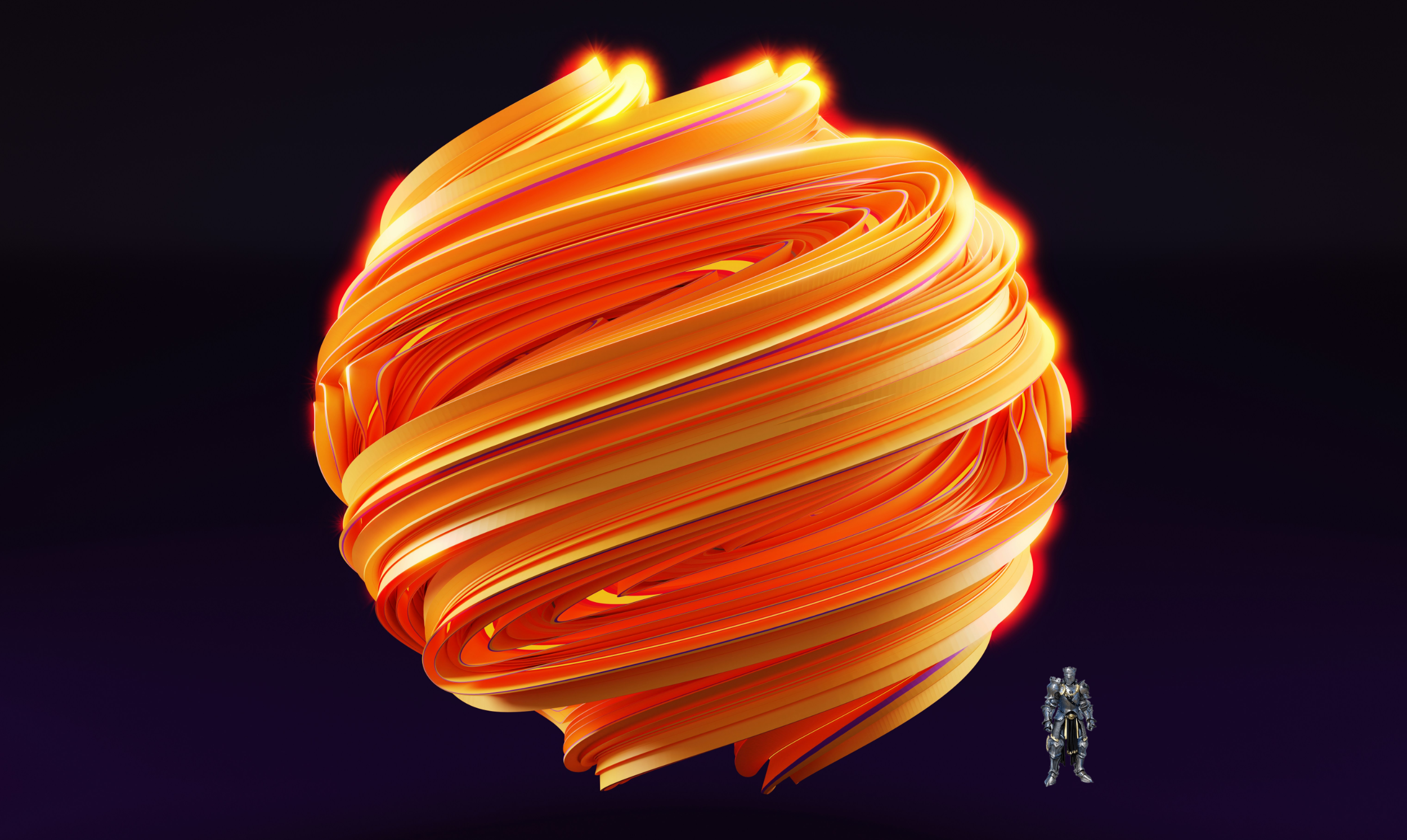
(Photo by BoliviaInteligente on Unsplash, knight added by the author)
But how big are we really talking? The volume of a sphere with radius 20' (~6.1m) can be calculated with the formula:
V=4/3πr3
Wolfram Alpha tells us that's 33,510ft3, which is 948.9m3 in not-USA numbers. Here's where the bat guano hits the fan.
The spell description states, "[a] bright streak flashes from you to a point you choose within range and then blossoms with a low roar into a fiery explosion." Based on the physics and chemistry that we're very much glossing over here, but paying a little more attention to the firefighting training I've received, a few things are happening. Let's enumerate them:
- The sulfur and guano are somehow being thrown out in a highly contained, compressed, and mixed form to as much as 150' (45.72m) away, at which point, some form of magical ignition (that we can choose to ignore the actual chemistry of for the purpose of this post) occurs.
- The ignition of the spell's material components potentially does two things that cause the "low roar":
- the material components rapidly expand into a cloud of flammable aerosolised powder or vapour that fills the 40' sphere in the instant before ignition and we're hearing the outward displacement of air and would feel that as wind moving past us if we were close enough, and;
- at the instant of ignition, the nascent fireball, undergoing a state transition, draws in oxygen from the surrounding air to act as feedstock for the explosion and we're hearing that air move toward the ignition point and would again feel the wind from this as air moving from behind us toward the spell (assuming we're facing it).
- The cloud that has expanded (we're not going to do the science for the Ideal Gas Law, as I last did this kind of physics in high school and I'm a writer and designer by trade, not a physicist) to fill the volume it is in and as described above, the cloud ignites from the centre of the spell and burns rapidly outward.
Now, if we're in an open field, an arena, a large temple, a big cave or other large open space we're doing okay here and our spell goes off doing the expected 8d6 damage to whatever foe happens to be standing in the way.
But we're not here for the easy way out, are we?
Ground burst or air burst?
As we've postulated above, the cloud of gas or dust that is the fuel for the fireball expands and fills the available space evenly out from the point of origin. Again, if we're in a big open space and we cast that point of origin to be 20' or more above the ground, we get a standard Fireball. In explosive terms, that's an air burst.
But how often in our games are we in places like that when we feel the need to cast terrifying death flames? Not often I'll warrant. Far more frequently, we're somewhere at least partially enclosed.
So, what's going to happen? I'm glad you asked.
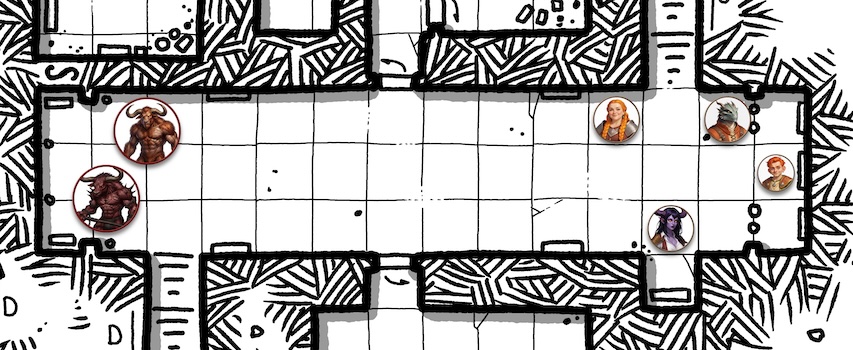
From our math above, we learned we generate 33 thousand-ish cubic feet of fire once the Fireball goes off. Exciting! If we think about that in terms of D&D's stereotypical map of 10' cubes, that's 33-and-a-bit of those cubes we're about to fill with fire. Thanks to the generosity of Dyson Logos, we have a wealth of maps we can demonstrate this on, but let's choose this one - The Ancient Temple of Torrel. Let's make some helpful assumptions about this map and place ourselves and some foes on the map:
- the squares on the map are 5', so a human, or human-sized creature, fills one square
- the hall, as drawn, is 70' long and 15' wide, and while we don't have a definitive ceiling height, let's decide it's also 10' high (as it's a subterranean excavation), that gives the room a total volume of 10,500ft3, or 31.3 per cent of the volume of a Fireball
- 10ft3 is an area 2x2 squares and 2 squares tall, with a total volume of 1,000ft3, so the blast fills 33½ cubes
Our party is made up of :
- Nekkolir Rubyborn, a 5th level dwarven paladin with 29hp
- Vaktith, a 6th level silver dragonborn cleric with 25hp
- Thogaxon, a 6th level tiefling rogue with 24hp
- a 5th level gnome wizard by the name of Flamdoosip, rocking 20hp
They have just emerged from the stairs connecting Level 1 to Level 2 and entered the large hall on the second level. At the far end of the hall, their presence has disturbed a pair of now-irritated minotaurs, who look to be about to engage. Initiative is calculated, and for whatever reason the Fates have chosen, our friend Flamdoosip goes first, announcing, "I cast Fireball!"
At this point, our DM, aware of the discussion we've been having here, and a touch amused by the chance of a TPK through misadventure (and inclined to allow a do-over if things go very badly), lets the spell be cast, asking where the wizard is casting the origin point.
While blessed with good Intelligence, our wizard has low Wisdom, his player having chosen that as a dump stat. He targets the spell to the wall between the columns behind the minotaurs, and 10' off the floor, as it's the furthest point available in the hall. Not the worst decision in the circumstances; he's allowed for the radius of the sphere to be far enough away not to blow back on the party, but has completely failed to account for the fact they are in an enclosed space.
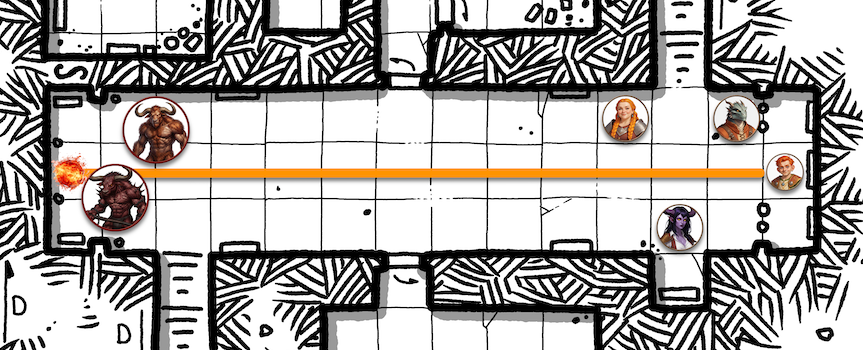
Loosing a Fireball in this space results in what is effectively a ground burst. The fireball has nowhere to go except expand out from the wall and into any nook or cranny it can find. Shit is, as they say, about to go down.
Let's see how much space this fireball takes up. As we know, it has a volume of 33,510ft3, or 33½ 10'x10'x10' cubes. Real-world physics indicates that the aerosol/vapour will fill out to any place it can. If it ignites in the process, the flaming ball will behave similarly. The pressure wave and flame from the blast will smash open doors, climb the stairs to level 1 and descend the stairs to Level 3.
What does that look like (I don't have the skill to animate this, so you're going to have to be satisfied with the after version)?
The image below shows the spread on Level 2. I've decided the pressure wave can't blow counter-swung doors out, though in reality, it probably would. I've also not mapped the effect on Levels 1 and 3, so the spread shown is about 75% of the full potential spread.
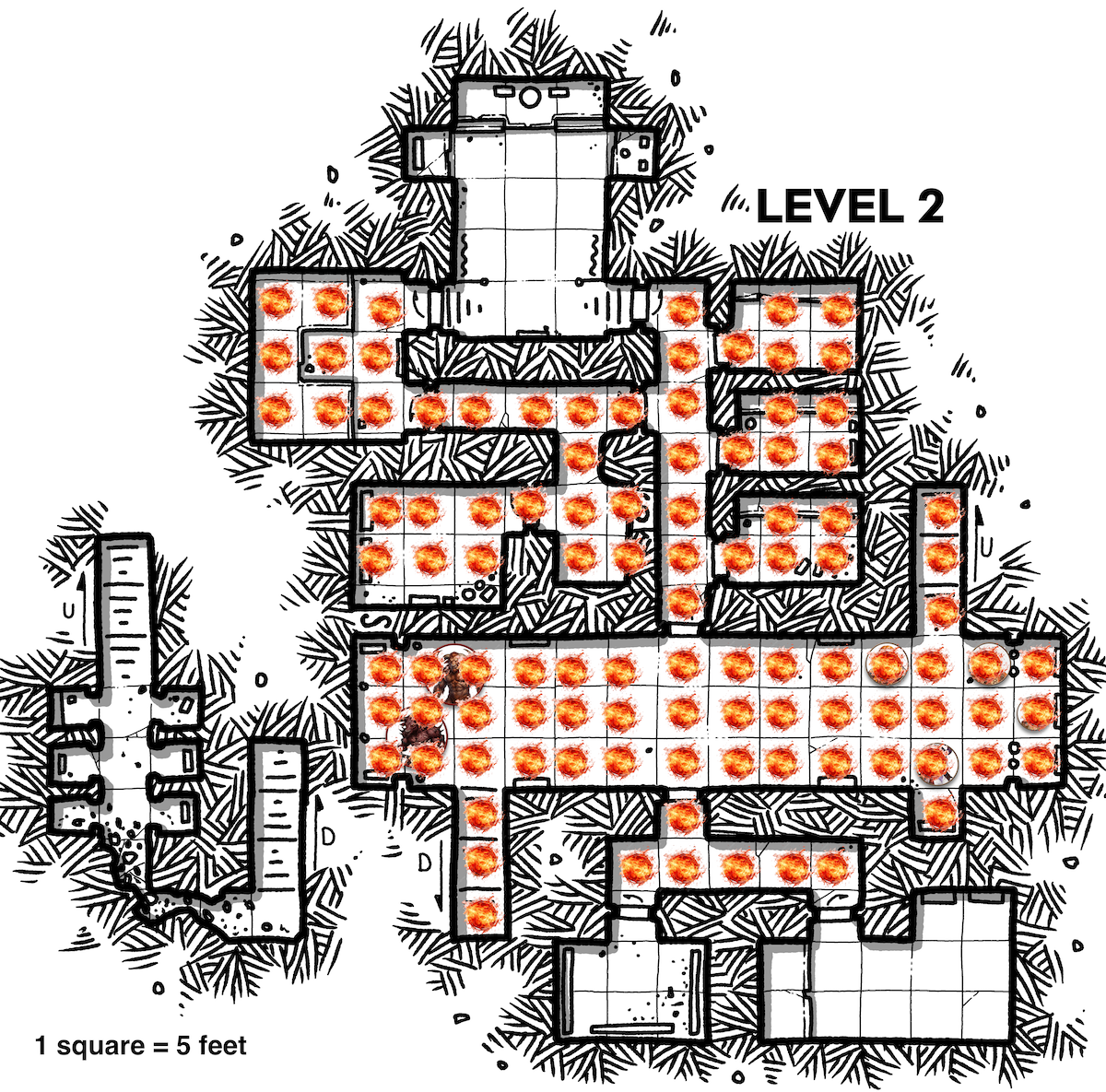
The 2024 Player's Handbook states that Fireball deals equal damage to all creatures in the blast, so rolling we get 29hp damage. There's a chance to reduce damage to half with a successful Dexterity saving throw.
Let's see how those saves go against the DC 15 Flamdoosip casts at. For simplicity, I'm going to assume each monster and character has the stats either in their 2024 Monster Manual stat block or the standard class array on p38 of the 2024 Player's Handbook:
- Jason, our first minotaur with 75hp, rolls a 2 and takes the full force of the blast, reducing him to 46hp
- Kylie, our second minotaur with 76hp, rolls 6 and also gets the entire load, reducing her to 47hp
- Nekkolir, the closest member of the party to the ignition has a Dex of 10 and no modifiers, rolls 16 for a successful save and takes 14hp damage, reducing him to 15hp
- Thogaxon has a Dex of 15 for +2 and rolls a 7, resulting in a modified 9 and is reduced to 0hp
- Vaktith has a Dex of 8—a -1 modifier—and rolls 13, a modified 12 and is also at 0hp
- Flamdoosip, our trigger-happy caster with a Dex of 12 for a +1 modifier, rolls a 14 and tops it up to 15, saving and taking 14hp damage, leaving him with 6hp
What else?
At this point, even if we got excited about flame spread, we could stop our exploration. But who wants that!? There are several additional effects we can explore that would happen in the real world. Whether you might choose to include them in your homebrew is up to you, so I'll include some possible in-game consequences.
We already know our standard Fireball spell produces Fire damage. The 2024 Player's Handbook describes Fire damage as "Flames, unbearable heat". But how hot and how much catches fire or is burned or vaporised?
The real world thing a Fireball most closely resembles is a backdraft (rapid introduction of oxygen to a fire) or flashover (heat ignition of smoke particulates). These phenomena are both rapid accelerations of fire with spectacular effects. In volunteer firefighting, while we train to prevent, identify, and manage both, the flashover is the most likely. ISO 13943 defines flashover as a "transition to a state of total surface involvement in a fire of combustible materials within an enclosure."
In heat terms, a flashover burns around 1100℉ (nearly 600℃). At that temperature, plate metal armour may warp and chain and other piece armour is likely to burn into the skin and muscle beneath, and it is well above the temperature necessary for 3rd degree (full thickness) burns. It's not quite as hot as is needed for a cremation. Clothing and leather will be carbonised.
Translating these kinds of temperature and fire effects into D&D is pretty difficult if you want to maintain a survivable fantasy world, so I'm not going to try.
What you might choose to do is have the players experience irrecoverable damage to their equipment that requires rapid back out from the situation, a return to camp for fresh clothes, and travel to the nearest town or village for repairs and replacements for damaged armour and clothing.
The other type of injury a PC might experience thanks to a Fireball is blast injury. That's exactly what you think it is. The US Department of Defense Blast Injury Research Coordinating Office describes it as:
A blast injury is a complex type of physical trauma resulting from direct or indirect exposure to an explosion. Blast injuries range from internal organ injuries, including lung and traumatic brain injury (TBI), to extremity injuries, burns, hearing, and vision injuries.
That site also goes into detailed analysis and description of blast injuries that may be of interest.
If one was inclined to play hyper-realistic injury effects in TTRPGs, you could build mechanics for this. I'm sure there's at least one system out there where it's been done (leave a comment if you know one so I can take a look).
In game terms, you could take an easier approach and apply an additional set of Bludgeoning damage at 4d6 to creatures and PCs caught in a Fireball. TPK isn't usually a desirable outcome, so judicious application of this probably makes sense.
Environmental damage is a consequential and serious outcome after a Fireball. Wooden furniture will be reduced to char, doors opening away from the ignition will be blasted open and off their hinges and counter-swung doors will be severely charred, if not also blown out, depending on how far from the ignition point they are.
So, what next?
Implementing completely realistic physics, chemistry and consequences of a Fireball at your table is probably neither easy or entirely desirable. However, I hope I've given you enough fuel (pun intended) here to add a wealth of colourful description to the next time an over-eager spellcaster lets off a Fireball indoors. Plenty of what's here can be used without destroying the party or unbalancing your game.
Please let me know if you enjoyed this post, and particularly if you'd like me to explore more real-world spell effects.
References
- Michael Bohnert, Thomas Rost, Stefan Pollak. 1998. The degree of destruction of human bodies in relation to the duration of the fire, Forensic Science International, Volume 95, Issue 1, Pages 11-21, viewed 30 May 2026, https://www.sciencedirect.com/science/article/pii/S0379073898000760
- Curran, Chris. 13 September 2021. The physics of the Fireball, Dump Stat, viewed 15 May 2026, https://dumpstatadventures.com/a-players-perspective/real-world-questions-in-a-fantasy-game
- Larwood, Phillip. 21 February 2021, The Wizard’s Playbook: Fireball, Kobold Press, viewed 30 May 2026, https://koboldpress.com/the-wizards-playbook-fireball/

Comments